Residential main sewer laterals across Los Angeles face severe structural stresses from invasive root systems and aged structural materials. Properties in older neighborhoods such as Silver Lake, Los Feliz, Highland…
Residential main sewer laterals across Los Angeles face severe structural stresses from invasive root systems and aged structural materials. Properties in older neighborhoods such as Silver Lake, Los Feliz, Highland Park, and Echo Park frequently run 4-inch or 6-inch vitrified clay pipes. These lines develop disjointed hubs and heavy ficus or palm root blockages every 24 to 36 months. Mid-century and modern parcels in Sherman Oaks, Brentwood, and Westwood commonly feature deteriorating cast iron that develops internal rust scaling, leading to solids snagging and eventual line collapse. In high-density settings throughout Koreatown and Boyle Heights, or coastal soils in Venice near sea level, settling ground shifts pipe pitch, creating recurring low-spot bellies that collect grease and waste water.
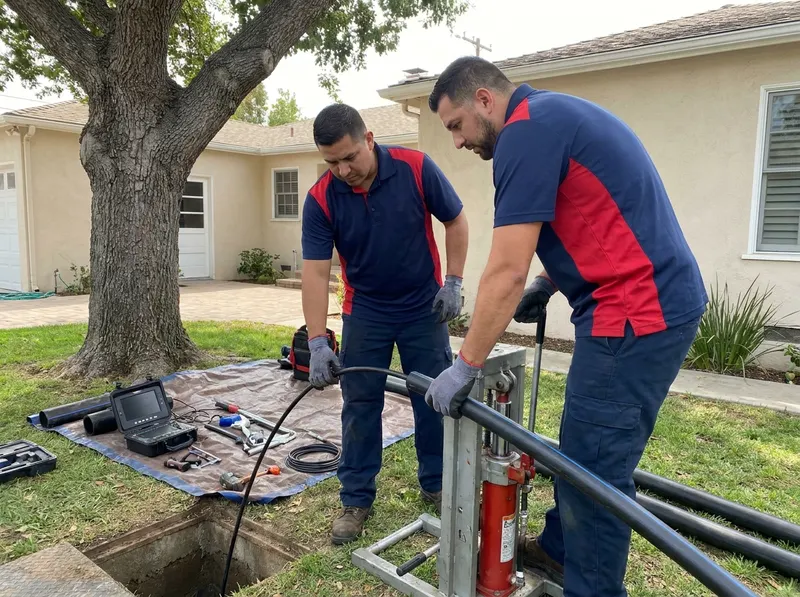
Trenchless restoration offers two primary methods that avoid destroying concrete flatwork or mature landscaping. Cured-in-place pipe (CIPP) lining pulls an epoxy-saturated felt sleeve through an existing cleanout, which cures in 3 to 5 hours into a seamless, joint-free structural cylinder rated to ASTM F1216 standards. Pipe bursting utilizes a high-powered hydraulic pulling machine to fracture the deteriorated clay or cast-iron line outward while simultaneously drawing through a continuous run of high-density polyethylene (HDPE) pipe of identical or expanded diameter.
Decision guidance depends strictly on pipe integrity and grade. If a clay pipe retains its circular profile and exhibits root penetrations at the joint hubs, CIPP epoxy inversion relines the host pipe with zero surface excavation. If the host pipe exhibits back-pitch, complete structural collapse under a concrete slab, or severe wall displacement exceeding 30%, pipe bursting or targeted open-trench point repair is required to re-establish true gravity slope. Epoxy liners cannot correct pipe bellies or missing structural sections, because the flexible resin conforms directly to the host pipe's existing contours. The practical trade-off is surface preservation versus mechanical slope correction: lining protects finished hardscaping, while open-cut spot excavation resets physical fall over damaged ground sections.
Municipal lateral connections introduce non-obvious logistics across Los Angeles County. While the homeowner owns the line from the home foundation to the municipal main connection under the street, work extending past the property boundary into the public roadway requires a Class A or B-Permit from the Los Angeles Department of Public Works, along with certified traffic control. Work remains localized within private cleanout portals whenever possible to bypass standard street-opening municipal permit delays.
Every job gets a firm, written price after a free on-site visit.
Tell us about your sewer line repair and trenchless replacement job in los angeles and we'll send a clear, written quote, usually the same day.
 UrbanFix Handyman